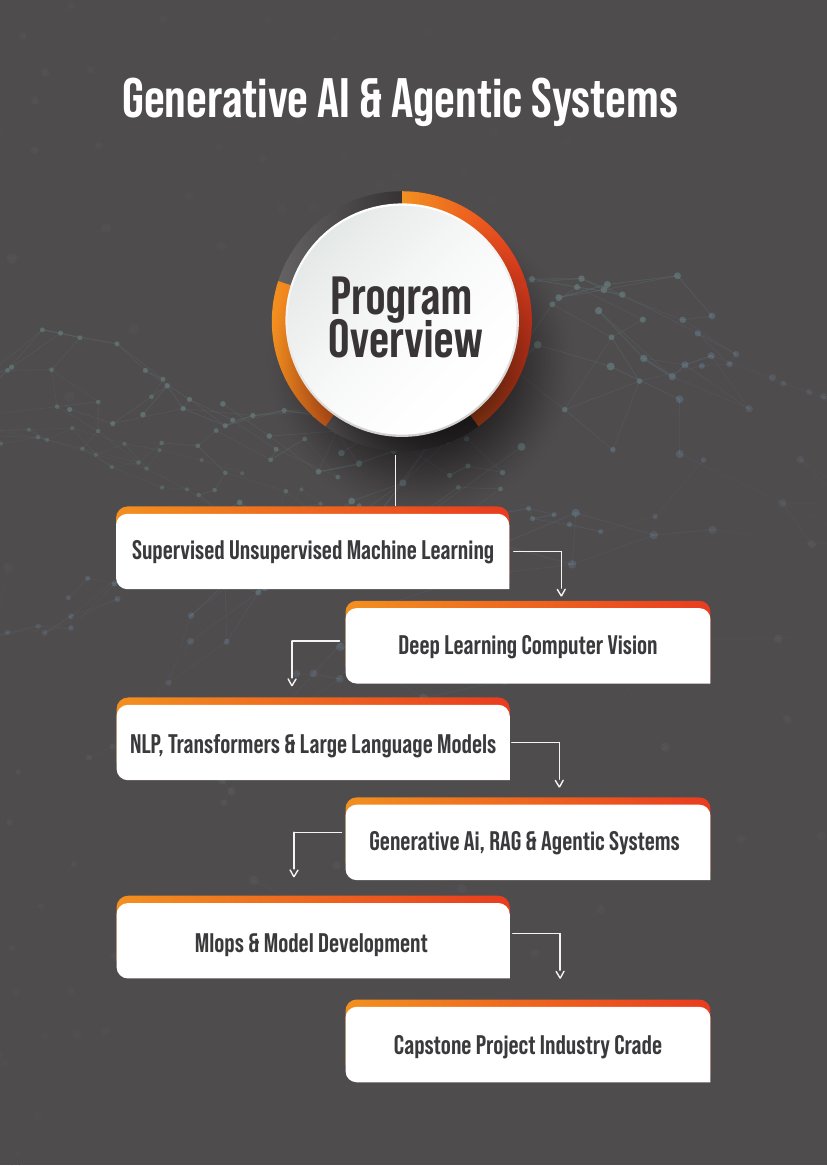
From Machine Learning and Deep Learning through NLP, Transformers and Large Language Models to Generative AI, RAG and Agentic AI systems, deployed with MLOps and finished with an industry-grade capstone project.
Choose how you learn: in the classroom at our Hyderabad centre, or live online from anywhere in India. Both modes follow the same 4-month syllabus, with the same faculty and the same hands-on projects.
| Location | Mode | Date | Start Time | |
|---|---|---|---|---|
| New batch dates will be announced soon. Please call us or send an enquiry. | ||||
Scikit-learn · Regression · Trees · SVM · Clustering · Evaluation
Outcome: Confidence to build, evaluate, and explain any ML model — in interviews and in production
TensorFlow / PyTorch · CNNs · Transfer Learning · Object Detection
Outcome: Build real-world image-based AI systems — using state-of-the-art architectures
GPT · HuggingFace · Sentiment · Prompt Engineering
Outcome: Master the fundamentals of Transformers and Large Language Models to build production-ready NLP applications, semantic search systems, and AI-powered chatbots
LangChain · LangGraph · Agents · Vector DBs · MCP · A2A
Outcome: Design and build autonomous AI systems powering modern real-world AI products
FastAPI · React JS · Docker · Git · Cloud · CI/CD · Monitoring
Outcome: Deploy and maintain production-grade AI models like a professional ML Engineer
Data → Model → API → Dashboard → Cloud → Portfolio
Outcome: A job-winning, fully deployed AI portfolio project ready for top industry roles
From students of Vector India’s Full Stack Development program

I'm B Sai Sushma, and I'm happy to share that I've secured an opportunity at Delta IoT, Pune through campus placements at Vector India Pvt. Ltd. My journey at Vector India has been truly transformative. The Full Stack (MERN Stack) training played a crucial role in strengthening my core fundamentals. The teaching methodology was very clear, structured, and easy to grasp, which made even complex concepts feel approachable. I'm especially grateful to Shekhar Sir for his continuous guidance and support throughout the course. The hands-on lab sessions and regular assessments greatly improved my skills and consistency. I also thank the placement team for their support throughout the hiring process. Overall, my experience at Vector India has been very positive and impactful.

My name is Pushpa Shree Bellamkonda and I'm glad to share that I got an opportunity to start my career at ADP Hyderabad through campus placements from Vector India. The training here really helped me strengthen my basics, especially during my MERN Stack course. The teaching approach was simple and easy to follow, which made learning much more effective. I would like to thank Shekar Sir for his support and guidance throughout the course. The lab sessions gave me good practical exposure, and the regular tests helped me stay on track. The placement team supported me well during the hiring process and helped me reach this milestone.

Hi, I am O. Agasteen Babu. I secured a job at Brillio Technologies with a package of 6 LPA through Vector India Institute, Hyderabad. I sincerely thank the placement department for their continuous support and guidance from the first interview round until I received my offer letter. The training by Shekar Sir is very effective, covering the MERN Stack along with additional skills like Python, Java, and problem-solving from the basic level. The institute provides good lab practice with one-to-one monitoring, and the training also includes skills based on current market trends. Overall, Vector India is a great place to build strong programming skills and start a career in the IT industry.

Hi, I am Yeggena Deependra Reddy. I secured a job at Hyundai Motors with a package of 3 LPA through Vector India Institute, Hyderabad. I sincerely thank the placement department for their continuous support and guidance from the first interview round until I received my offer letter. The training by Shekar Sir is very effective, covering the MERN Stack along with additional skills like Python, Java, and problem-solving from the basic level. The institute provides good lab practice with one-to-one monitoring, and the training also includes skills based on current market trends. Overall, Vector India is a great place to build strong programming skills and start a career in the IT industry.

I had the opportunity to pursue full stack web dev at Vector Hyderabad. The curriculum was structured in a way that steadily built confidence, especially through their regular, hands-on assignments/tests and implementing real world projects. One of the things I appreciated was how they kept pushing us toward real-world readiness instead of just theory.By the end of the full stack development program, I was able to land a role through their on campus placement support, which made the entire journey feel worthwhile.

I joined Vector for the Python Full Stack Development course, which spanned six months and provided excellent exposure to a wide range of technologies. The teaching quality was outstanding, and the trainers explained every concept in a clear and practical manner. The course helped me build strong technical skills and boosted my confidence. Thanks to the training and guidance I received at Vector, I secured a campus placement at Mirafra Technologies with a package of 3.5 LPA. I am truly grateful for this learning experience and the support provided throughout the journey.

I'm Akarsh Chowdary enrolled at Vector India for the MERN Full Stack Development program, and the experience has been exceptional. Under the guidance of Shekar Reddy Sir and Sai Teja Sir, I gained strong technical expertise through structured teaching, real-time problem-solving, and practical lab sessions. Satish Sir’s communication classes greatly enhanced my soft skills and confidence. The dedicated lab hours and highly supportive lab coordinators ensured that doubts were clarified immediately, which strengthened my learning further. I’m also grateful to the placement team for their consistent support and timely guidance throughout the recruitment process. I’m pleased to share that I have secured a position at Mirafra Technologies with 3.5LPA, and I extend my heartfelt thanks to the entire Vector India team for shaping my career.

I completed my graduation in Sphoorthy Engineering College, which is affiliated to JNTUH. After that, I came to Hyderabad to pursue a Full Stack Development course at VECTOR INDIA. Honestly, joining Vector India was one of the best decisions I’ve made — the training was very practical, and the faculty explained every concept in a clear and simple way. With their continuous support and excellent placement assistance, I got placed in M2NXT Company with 3.6LPA. I’m really thankful to Vector India for helping me build a strong foundation and start my career in the IT field. I truly recommend VECTOR INDIA’s Full Stack course to anyone who wants to gain real-time knowledge and get placed in a good company. It’s the best place to learn, grow, and begin your professional journey. Thanks to VECTOR INDIA for being a big part of my success.

Hi everyone, I’m Raju Sivakoti, and I’m thrilled to share my learning journey with Vector India, where I was trained to become a Full Stack Developer. One of my friends recommended Vector India for its professional-level training, and I must say, the experience truly exceeded my expectations. The advanced teaching methods, hands-on projects, and expert trainers helped me build strong technical and professional foundations. A special thanks to Reddy Shekhar Reddy Sir for his valuable guidance and professionalism, and to Satish Sir for the soft skills sessions. The placement team was incredibly supportive and stood by us even during challenging times. I’m delighted to share that I’ve been placed at M2NXT Solutions Pvt Ltd as a Graduate Trainee Engineer – R&D Department, with an annual package of 3.6 LPA. I extend my heartfelt gratitude to the entire Vector India team — from the trainers and placement coordinators to the front desk and backend staff — for their constant support throughout my journey.

I am Jaswanth Kumar, and I completed my engineering from Abdul Kalam Institute of Technological Sciences, Kothagudem. I came to pursue the Full Stack Development course at Vector India to build a strong foundation in software development.The course was well-structured and very helpful. It provided in-depth knowledge of both frontend and backend technologies, which really helped me gain confidence and hands-on experience in Full Stack Development. I chose Vector India because of its reputation for quality training and its strong focus on practical learning. The trainers were supportive and explained concepts clearly, which made learning more effective. The placement assistance program was very supportive and guided me throughout the process—from resume building to mock interviews. It helped me prepare well for actual job interviews. Thanks to Vector India, I was able to get placed in Qodic Technosoft with 2.4LPA and it really helped shape the start of my career in the software industry. I would definitely recommend Vector India’s Full Stack Training Program to anyone looking to build a career in software development. It’s a great place to learn, grow, and get placed.

Hi everyone, I'm Venkatesh Madanwale. I'm excited to share my journey with Vector India, where I became a Full Stack Developer. My sister recommended Vector India for its professional-level training, and I was impressed by the advanced methods and expert trainers. The placement team was also very supportive, even during the recession. I had a great experience with Reddy Shekhar Reddy Sir, who provided valuable guidance and professionalism. Satish Sir's soft skills training was also enjoyable and insightful. Thanks to the trainers and support team, I got placed at Mirafra Technologies as a Software Engineer with the annual salary package of 3.5lpa. I'm grateful to the entire Vector India team, including the front desk, backend, teachers, and placement team.

To explore MERN stack technologies, I joined Vector India after learning about it through a friend. The institute provides excellent teaching, covering each module with great clarity. With the guidance of the faculty, I was able to master every module thoroughly. I am thrilled to share that I have been placed at Triad Software Pvt. Ltd. with a CTC of 5.4 LPA. I sincerely thank my faculty, the HR team, and the entire Vector India Institute for their support and guidance throughout my journey.

I am extremely grateful to my institute for playing a crucial role in helping me secure a placement. The continuous support, guidance, and training provided by the faculty and the placement cell equipped me with the necessary skills and confidence to perform well during the recruitment process. From technical knowledge to soft skills, the institute ensured that I was prepared for every stage of the selection procedure. The mock interviews, workshops, and industry exposure offered by the institute were instrumental in shaping my career and helping me secure a job in Delta IoT Solutions with 3lpa. l achieved this milestone. I sincerely thank the entire team for their dedication and efforts toward my professional growth.

I am Iranna (V24HFS1I1), and I am thrilled to share one of the most memorable and proud moments of my journey. I want to express my heartfelt gratitude to my parents and everyone who encouraged me to join Vector India Pvt Ltd. It has truly been one of the best decisions of my life. A special thanks to the entire Vector Team for their unwavering support and guidance. The faculty's mentorship, hands-on training, interactive sessions, and motivation played a crucial role in boosting my confidence and preparing me to tackle challenges effectively. I am excited to embark on this new chapter with SD Wot with 2.4lpa, and I look forward to applying the skills and knowledge I have gained.

I'm Prasanna V23HFS1C3, by my friend's brother suggestion I have joined Vector India hyderabad in MERN Stack development. My aim is to upskill and get placed. Shekhar sir delivers the excellent knowledge of technologies, he is very friendly and clarifying the doubt by using live examples. The HR team is more reliable in conducting drives. Especially Sathyam sir and Mercy mam are very supportive and being available to students all the time and encourages to perform well. I have reached to final rounds in many companies like Astreya, GSPANN, Carrier, L&T etc. Even though I am good at technical but luck didn't favoured me many times but I didn't give up myself easily and I continue to try for next companies. Also I had lost high package companies, I didn't get demotivated. And finally I got placed in AMI company with 4Lpa. Thanks for the vector team for supporting and encouraging me in reaching my goals.

Hi, This is YaminiThangella, I would like to express my heartfelt thanks to Vector India Institute for helping me kickstart my career. The Full Stack course was well-structured, and the faculty was always supportive. Their commitment to providing excellent placement opportunities has led to my successful placement in a Good company. I highly recommend Vector India for anyone looking to advance their career in tech.

I completed my graduation in University college of engineering Kakatiya University, kothagudem. And I came to Hyderabad for taking full stack course and I really found the best institute VECTOR INDIA. And the course was very helpful to me. I really gained knowledge and got placed in NCR CORPORATION. My brother suggested me this institute. And this the best place to learn full stack. VECTOR INDIA Placement assistance helped me very much to place in NCR Company. Vector India really useful for setting my career.My career got started because of Vector only. For sure I'll recommend VECTOR full stack training for the students who want to learn and gain knowledge..... this institute will help you very much in getting a job and starting the career. Thanks to vectorindia.

I am Chepuri SaiMurali Krishna from Anurag Engineering College, Kodad, Suryapet. I am a CSE - B. Tech graduate of 2023 batch. The Full Stack Development course is really good at Vector India. I joined the institute on my cousin's suggestion, after checking reviews of previous students who got placed in many companies. Placements team at Vector India is really good, they supported me and moulded me. My goal to get placed in my dream company came true due to the support from the team of Vector India. I will definitely recommend this institute to my friends and relatives to fulfill their desire in getting placed in their dream company.

I'm Vishnu Vardhan Reddy, from a Computer Science and Engineering background, and I joined Vector India with a strong passion for Full Stack Development. My experience here has been very valuable. The institute gave me a solid foundation in both front-end and back-end development, covering essential technologies, frameworks, and database management. The faculty are very supportive and explain concepts clearly with real-time examples, while the lab sessions and workshops provided me with excellent hands-on experience. The placement support is also very good, offering opportunities in many core companies. I got placed in FISClouds with a salary of 2.4 LPA. Overall, Vector India has been a great step in shaping my career, and I would definitely recommend this institute for future batches who wish to build their career in the full stack domain.

Vector India Pvt. Ltd. is an excellent institute for anyone looking to build strong technical skills. I completed the MERN full stack development course here, and the training was comprehensive, covering both theoretical concepts and practical applications. The curriculum is well-structured and highly relevant to the current industry demands. The faculty is knowledgeable and supportive, ensuring that every student has a clear understanding of the subjects. They take a personalized approach to help students excel and gain confidence in their technical abilities. I am pleased to share that I secured a placement at Befach 4x Pvt. Ltd. with the help of the dedicated placement cell at Vector India. Their commitment to student success is evident in the continuous efforts they make to bring in top companies and provide ample opportunities for placements. I highly recommend Vector India Pvt. Ltd. to anyone looking to advance their career in the tech industry. Their training and placement support are truly top-notch!. Thanks to vectorindia.
A 4-month course, in the classroom at Hyderabad or online, in six modules: machine learning, deep learning and computer vision, NLP and Large Language Models, Generative AI with RAG and AI agents, MLOps, and an industry-grade capstone project.
Python programming and basic data analysis with NumPy and Pandas. Logical thinking and willingness to learn are essential.
Both. You can attend in the classroom at our Hyderabad centre, or join live online classes from anywhere in India. Both modes follow the same syllabus, with the same faculty and the same projects; online classes run live at the same time as the Hyderabad batch.
Online classes are live and instructor-led, in secured Zoom sessions with the same faculty who teach in the classroom, so you can ask questions and clear doubts in real time. A dedicated Learning Management System (LMS) gives you the course content and assignments.
Hands-on projects in every module — for example a customer segmentation system, a YOLO object detector, an LLM chatbot, a production RAG system, multi-agent systems with LangGraph and CrewAI and a custom MCP server — and one industry-grade capstone project with a GitHub repository and a deployed web application or API.
Supervised learning (regression, decision trees, random forests, XGBoost, LightGBM, CatBoost, SVM), unsupervised learning (K-Means, DBSCAN, PCA, anomaly detection), model engineering and interpretability (SHAP, LIME), neural networks with TensorFlow / PyTorch, CNNs, transfer learning (ResNet, EfficientNet) and object detection with YOLO, then NLP, sequence models and Transformers.
Large Language Models (GPT, Gemini, Claude) and prompt engineering, embeddings and vector databases (FAISS, ChromaDB, Pinecone), Retrieval-Augmented Generation (RAG) including conversational, Graph and Agentic RAG, AI agents with tool calling, planning and memory, multi-agent systems with LangGraph and CrewAI, the Model Context Protocol (MCP) and Agent-to-Agent (A2A) protocol, and evaluation, guardrails and responsible AI.
Yes. The MLOps module covers Git and GitHub, serving models with FastAPI (with Swagger documentation and JWT authentication), React basics for AI front ends, Docker, CI/CD with GitHub Actions, deployment on AWS (EC2, S3, RDS), and model monitoring and drift detection.
An industry-grade, end-to-end project on a real-world problem: data collection and pipeline design, EDA and feature engineering, model building and evaluation, a Generative AI or agentic component, a FastAPI backend, Docker containerisation and deployment to the cloud. You finish with a GitHub repository (clean code, README, architecture diagram and demo instructions) and a deployed web application or API accessible via a public URL.
Yes. Placement assistance is provided to students who meet the placement eligibility criteria: at least 75% attendance and a 40% internal score in theory, lab and internal assessments, recommendation in the mock interview and communication skills assessment, and successful completion of the prescribed projects. Online students who want placement assistance must also score at least 40% in the Placement Eligibility Test, held in person at the institute.
The capstone phase includes career preparation: setting up your GitHub portfolio, resume preparation guidance, technical interview preparation and mock interviews with feedback. Your deployed capstone project and the projects you build during the course form your portfolio.
Admission is direct: there is no entrance test. Click Apply Now or Enquire Now on this page and fill in the form, or call us, and our team will help you with the next batch and enrolment.
Yes. At the end of the course, students receive a Merit / Course Completion Certificate, provided they meet the eligibility in terms of attendance and internal assessments.
Our vision is to empower the next generation of AI professionals with industry-focused education that bridges the gap between academic learning and real-world applications, developing AI engineers who build intelligent, scalable and production-ready solutions.